

October 4, 2026
Three Part Rehearsal Scheduling System for School and Student Tours

The most effective approach to rehearsal scheduling on tour combines three elements: one master tour calendar that separates shows, travel, and rehearsal windows, a per-day advance sheet that acts as the single source of truth, and short, goal-driven rehearsal blocks sent to the right people through mobile day sheets. Build those three pieces first, then layer in the planning routines below.
TL;DR:
- Effective tour rehearsal scheduling relies on a master calendar, a single advance sheet, and mobile goal-driven rehearsal blocks to prevent overlaps and miscommunication.
- Rehearsal goals must be predefined for each session, with clear ownership assigned to the music director, tour coordinator, and local advance personnel to streamline planning.
- Use split schedules, filtered mobile day sheets, and preflight checks to optimize time, reduce errors, and adapt quickly to disruptions or last-minute changes.
- Protect rehearsal time by blocking it on the calendar well in advance and matching session lengths to travel and performance demands.
- Incorporate scheduled downtime, buffer periods, and flexible goals to support performer well-being and maintain morale throughout the tour.
Table of Contents
- Tour Rehearsal Planning Fundamentals
- Scheduling Methods and Tool Workflows for Tour Rehearsals
- Templates and Checklists for Rehearsal and Day Sheets
- Protecting Performer Wellbeing Across the Tour
- Handling Illness, Delays, and Other Rehearsal Disruptions
- Communicating Schedule Changes on the Road
- Balancing Rehearsal Time with Performances and Travel
- A Tour Coordinator’s Short Case for Preflight Checks
- How Group Travel Network Supports Rehearsal Scheduling on Tour
- FAQ
- Sources
Tour Rehearsal Planning Fundamentals
A master calendar is the spine of everything else. It should show every show date, every travel day, and every rehearsal window in one place, color coded or tagged so a music director can see at a glance where a 45-minute slot actually exists between a load-in and a sound check. Without that single view, rehearsal time gets guessed at instead of planned.
Each rehearsal slot needs a stated goal before it gets scheduled. A session built to learn new material looks nothing like one meant to refine a tricky transition or simply run a set start to finish. Naming the goal in advance, and communicating it to the ensemble, keeps a short session from drifting into an unfocused jam, a point echoed in guidance on effective rehearsal time that recommends setting clear goals for every session.
Ownership also needs to be explicit. On most tours:
- The music director sets rehearsal content and goals for each session.
- The tour coordinator owns the master calendar and fits rehearsal windows around logistics.
- A local advance person confirms venue access, room availability, and equipment on the ground.
A repeatable daily rhythm, arrival, settle, rehearse, eat, perform, travel, makes each new city easier to process for performers who are already managing fatigue and unfamiliar rooms.
Scheduling Methods and Tool Workflows for Tour Rehearsals
Once the master calendar and goals are set, the daily execution comes down to a handful of repeatable methods.
- Split schedules. Divide a large ensemble into A, B, and C parties so horns rehearse while strings do a sound check, or so featured soloists get dedicated time while the full group rests. This keeps total rehearsal hours down while still covering what each section needs.
- Day-sheet advances. Treat the daily advance, or day sheet, as the one document everyone checks. It should pull call times, driver assignments, venue contacts, and hotel information from the master calendar automatically rather than being retyped each day. Tour operations platforms built around a single record of truth populate day sheets this way, cutting down on the version confusion that happens when three people are editing three different copies of the same schedule.
- Filtered, offline-capable distribution. Not everyone needs every field. A driver needs addresses and times; a vocalist needs warmup and call times; a production manager needs load-in windows. Filtered mobile views, cached for offline use, keep each recipient looking at a shorter, more relevant sheet instead of a dense master document, and they still work when a venue’s basement has no signal.
- Preflight checks. Before any day sheet goes out, run a check for missing call times, unverified venue addresses, or absent hotel contacts. Automated preflight scans built into modern tour software catch these gaps before they become a 7 a.m. phone call looking for a bus that no one told where to go.
Pro Tip: Run your preflight check the night before, not the morning of: a missing address at 11 p.m. is an easy fix, the same gap at 7 a.m. is a crisis.
Pre-production advance work with audio and production staff matters just as much as the performer-facing schedule. Collecting who, what, where, when, and how well ahead of arrival, a practice detailed in guidance on audio pre-production planning, prevents the kind of day-of technical scramble that eats directly into rehearsal minutes.
Templates and Checklists for Rehearsal and Day Sheets

A day sheet earns its place as the single source of truth only if it consistently carries the same core fields. At minimum it should include call times for each group, a venue map or pinned address, the driver and local contact, hotel name and check-in time, and the day’s rehearsal goal stated in one line.
Rehearsal blocks are easier to plan when they follow a fixed shape rather than being improvised each day:
- 30-minute block: a brief warmup, focused time on the highest-priority problem, and a clean run of the affected section.
- 60-minute block: warmup, focused work on priority problems, time on transitions or set order, and a full run-through, a structure recommended in rehearsal-time guidance from the Incorporated Society of Musicians.
- 90-minute block: warmup, two problem-focused segments covering different sections, a transitions pass, and a full run-through with notes.
Before sending any day sheet, run a short checklist: confirm every call time is filled in, every address is verified against the venue’s current listing, and every contact number has been tested. Stamp the sheet with the editor’s name, the date and time of the last edit, and a one-line changelog so a crew member glancing at two versions on a group chat knows which one is current.
Protecting Performer Wellbeing Across the Tour
Rehearsal scheduling that ignores fatigue produces worse performances, not better ones. Research on touring musicians points to pre- and post-performance routines and scheduling practices as direct contributors to wellbeing and performance headspace, as described in a qualitative study on touring musicians. Scheduling is not just logistics; it shapes how performers show up on stage.
A few rules help:
- Build at least one genuine recovery window into every week, not just a travel day.
- Expect a dip in energy and focus mid-tour and schedule lighter rehearsal loads around it rather than after problems appear.
- Add short daily movement breaks and dedicated vocal rest periods for singers between sessions.
- Favor several short, problem-focused rehearsals over one long technical block that drains the group without adding much polish.
Pro Tip: Treat downtime as a scheduled line item on the day sheet, not leftover time: unscheduled downtime gets eaten by logistics, scheduled downtime actually gets used for rest.
Morale and attendance both tend to track with whether performers believe the schedule respects their limits.
Handling Illness, Delays, and Other Rehearsal Disruptions
Every tour eventually loses a rehearsal to something outside anyone’s control: a delayed flight, a sick section leader, a venue that double-booked the room. The fix is not a perfect schedule, it is a schedule with slack built in on purpose.
Keep a standing 15 to 20 minute buffer around at least one rehearsal block per day so a short delay does not cascade into a missed sound check. When illness takes out a key player, have a default fallback plan already decided, who covers the part, which sections get prioritized instead, and whether the session shifts to a different goal like blocking or staging rather than full ensemble work.
A single source of truth matters even more during a disruption. When a rehearsal moves or shrinks, that change should update the master calendar once and flow out to every filtered day sheet, rather than requiring five separate messages to five separate people. This is where the preflight-check habit pays off twice: once when the original sheet goes out clean, and again when a last-minute change needs to be verified before it reaches the group.
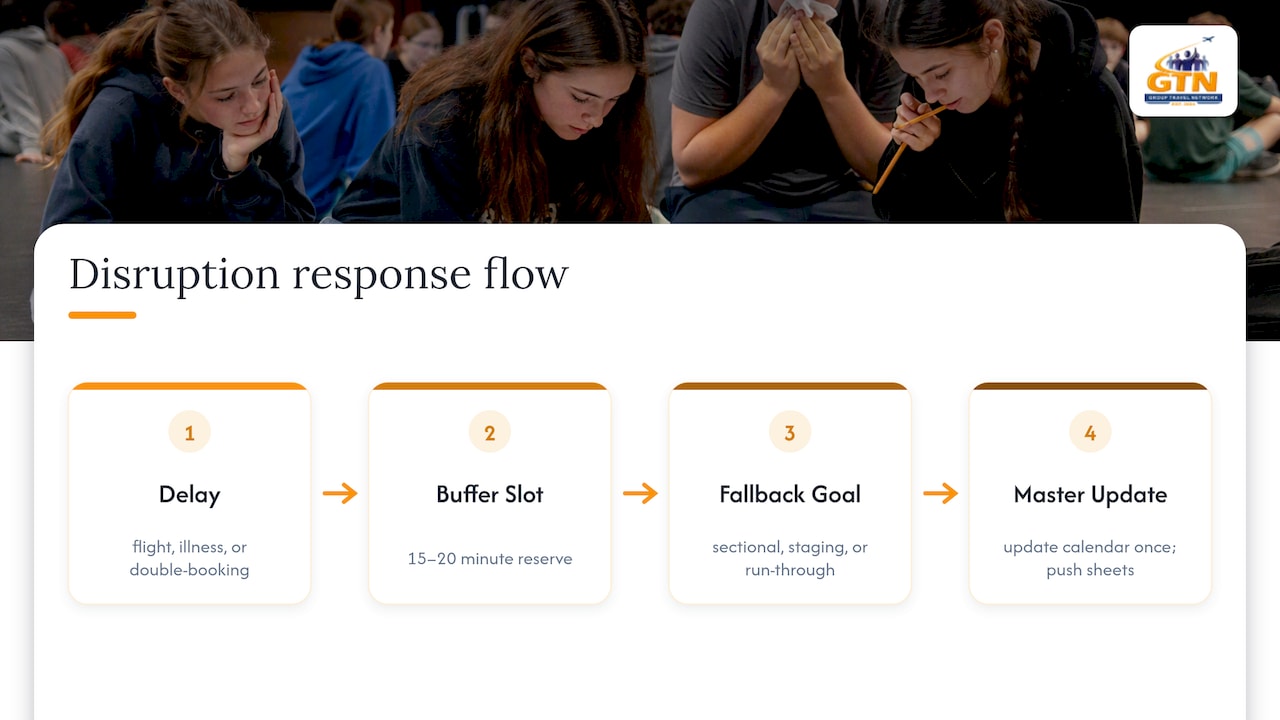
Keep a short list of adaptable rehearsal goals ready for exactly these moments: a run-through that needs only half the ensemble, a sectional that can happen in a hotel conference room, a staging walk-through that needs no instruments at all. Having those options decided in advance turns a lost rehearsal slot into a smaller inconvenience instead of a crisis.
Communicating Schedule Changes on the Road
A schedule change that only exists in one person’s head is not a schedule change yet. The habit that prevents confusion is simple: every change gets written into the master calendar first, then pushed out through the same day-sheet channel the group already checks, never announced only verbally at the end of a rehearsal.
Timestamp every update. A day sheet that shows when it was last edited, and by whom, lets a performer scrolling a group chat tell instantly whether they are looking at the current version or an outdated one. Pair that with filtered distribution so a driver gets the new pickup time without being buried in rehearsal notes meant for the woodwind section.
Designate one person, usually the tour coordinator, as the final word on schedule changes. Multiple people editing the same information independently is how two different call times end up circulating at once. A single owner, publishing through a single channel, removes that risk.
For larger groups, a short daily huddle, even five minutes, where the coordinator reads out anything that changed since the last sheet went out, catches gaps that a written update alone might miss, particularly for performers who skim their phones between rehearsal blocks.
Balancing Rehearsal Time with Performances and Travel
Rehearsal never happens in isolation on tour. It competes directly with travel time, load-in and sound check windows, and the performances themselves, and a schedule that treats rehearsal as infinitely flexible usually loses that fight.
The practical fix is to protect rehearsal windows the same way a show call time gets protected: block them on the master calendar before travel gets finalized, not after. A 45-minute slot that exists only “if there’s time” after a long drive will disappear the moment the drive runs long.
Prioritization matters as much as protection. On a day with a short travel window and an evening show, a focused 30-minute problem-solving block beats a 90-minute run-through that performers are too tired to benefit from anyway. Matching rehearsal length and intensity to what the day’s travel and performance load can actually support keeps quality from eroding over a multi-week run.
Coordinators who build rehearsal windows into the itinerary from the planning stage, rather than squeezing them in afterward, tend to have fewer last-minute conflicts between a bus departure and a group that still needs twenty more minutes.
A Tour Coordinator’s Short Case for Preflight Checks
On one multi-city run, a preflight check on the day sheet caught a call time listed for the wrong venue hall, twenty minutes before it would have sent half the ensemble to the wrong door. That single-source day sheet, checked before distribution, replaced what used to be five separate group texts with one sheet everyone trusted. The takeaway worth adopting immediately: never send a day sheet without running the missing-field check first.
— Donovan
How Group Travel Network Supports Rehearsal Scheduling on Tour
Rehearsal scheduling gets easier when the travel logistics around it stop demanding constant attention. We build custom itineraries that account for rehearsal windows from the planning stage, not as an afterthought squeezed between buses and hotel check-ins.

Working with a trip coordinator means a music director spends rehearsal time on music, not on confirming venue access or chasing a hotel contact. Our planning includes:
- Itineraries built around rehearsal, travel, and performance windows from day one.
- Partnerships that confirm venue and logistics details before arrival.
- Payment plans and travel protection options.
If your ensemble is planning a multi-city run, our Performance Tours service is built for exactly this kind of coordination. Reach out to start planning an itinerary that gives your rehearsals the time they need.
FAQ
How much rehearsal time is needed for a play or performance tour?
The right amount depends on the material and the group’s familiarity with it, so there is no single fixed number. A more useful approach is to set a specific goal for each session, learn, refine, or run through, and schedule short, focused blocks around that goal rather than defaulting to long open-ended rehearsals.
What is the rehearsal before a concert called?
The final rehearsal before a concert is commonly called a dress rehearsal or a run-through, depending on whether costumes and staging are involved. It typically focuses on performing the full set start to finish with minimal stopping, mirroring actual show conditions.
Who is responsible for the rehearsal schedule on tour?
Responsibility usually splits three ways: the music director sets rehearsal content and goals, the tour coordinator owns the master calendar and fits rehearsal windows around travel and shows, and a local advance person confirms venue and room details on the ground. Clear ownership of each piece prevents the kind of gaps that lead to missed call times.
What is the best strategy during rehearsal on tour?
Short, goal-driven blocks tend to outperform long, open-ended sessions, especially mid-tour when fatigue sets in. A structure that starts with a brief warmup, moves into focused problem solving, and ends with a short clean run-through keeps sessions productive without exhausting performers, an approach supported by guidance on effective rehearsal time.
Sources
- The Key to Effective Rehearsal Time
- Ready To Rock? Effective Audio Pre-Production Planning Before Going On Tour – ProSoundWeb
- StageKit Tour — Tour operations software for working acts
- Between the crowd and the band: performance experience, creative practice, and wellbeing for professional touring musicians
Recommended

Relax with our Student Travel Expertise .
We deliver stress-free student trips backed by an exceptional array of services you won’t find anywhere else:
- Stress-free, creative planning of customized itineraries
- Dedicated GTN Service host on every trip
- Extensive travel protection plan options
- Online, individual registration system
- Flexible payment plans and online payment options
- Bulk buyer discounts for great trips that cost less
Inclusion into #MyGTNFamily for life! (you don’t even have to remember our birthday!)
Spain
There is no place like Spain to offer a student performance opportunity or cultural student trip.
Myrtle Beach
All students love the beach! Especially a beach known for its 60 miles of pristine coastline.
Boston
Have your students experience colonial charm in the city that is considered the hub of New England.
London
Provide your student group with the “Royal” treatment! One of the world’s most recognized cities.
See What People Are Saying
“It has been my privilege to use Group Travel Network as the exclusive travel coordinator for my band for over 10 years. I can say, without doubt or hesitation, that GTN is, by far, the best travel company for student groups currently in existence. I have often said that I wouldn’t take my band across the street without GTN and that’s not far from the truth!”
“This was my first time using a company to plan our band trip. It was so easy working with Justin and Group Travel Network. We had to make several changes along the way, but they were accommodating changes and worked everything out for us. I would highly recommend using Group Travel Network.”
“What wonderful trip we had to NYC! Our group of 51 never missed a beat because of Group Travel Network and our wonderful guide, Tim. It was truly a theatre trip to remember! If you are looking for a travel company who really cares about the details, Group Travel Network is for you!”