

September 29, 2026
School Leaders: On Site Trip Support With SYTA and REMS Checklists

On-site trip support is a professional on-trip coordinator service that manages logistics, safety, and crisis response so school leaders can focus on students’ wellbeing. It works alongside the primary group leader, handling everything from hotel check-ins to emergency escalation, which cuts down on the number of decisions one exhausted chaperone has to make at 2 AM. It does not replace the leader’s duty of care, but it does give that leader a partner who knows the ground and the playbook.
TL;DR:
- On-site trip support involves detailed pre-trip risk assessments, emergency planning, and post-trip incident reporting to prevent recurring mistakes.
- The role is divided between the immediate crisis responders on-site and the group leader, who maintains legal responsibility and reviews emergency procedures beforehand.
- Implementing a clear crisis response sequence, including secure headcounts and documented incident protocols, reduces chaos during emergencies.
- A comprehensive emergency operations plan should include a vendor’s crisis plan, staff credentials, and regular drills to ensure effective support during incidents.
- Schools should verify that providers have documented crisis plans, staff first-aid training, and local vendor relationships to ensure reliable support in emergencies.
Table of Contents
- What does on-site trip support actually cover?
- Who’s in charge: the on-site coordinator or the group leader?
- What to do first when an incident happens on-site
- Building on-site support into your emergency operations plan
- How to vet an on-site trip support provider before you sign
- Quick-reference safety checklist for performance days and venue visits
- Why professional on-site support changes how a trip actually runs
- Let Group Travel Network handle the on-site details
- Where to find the source guidance and templates
- Sources
- FAQ
What does on-site trip support actually cover?
Coverage runs across three phases, and each one shapes whether a trip goes smoothly or falls apart at the first hiccup.
Before departure, a coordinator typically works through a risk assessment of the destination, collects student medical information, runs a pre-departure orientation, prepares emergency contact cards, and confirms travel insurance details. Groups that skip this stage often discover gaps only after something goes wrong, which is the worst possible time to find out a student’s allergy information never made it into anyone’s file.
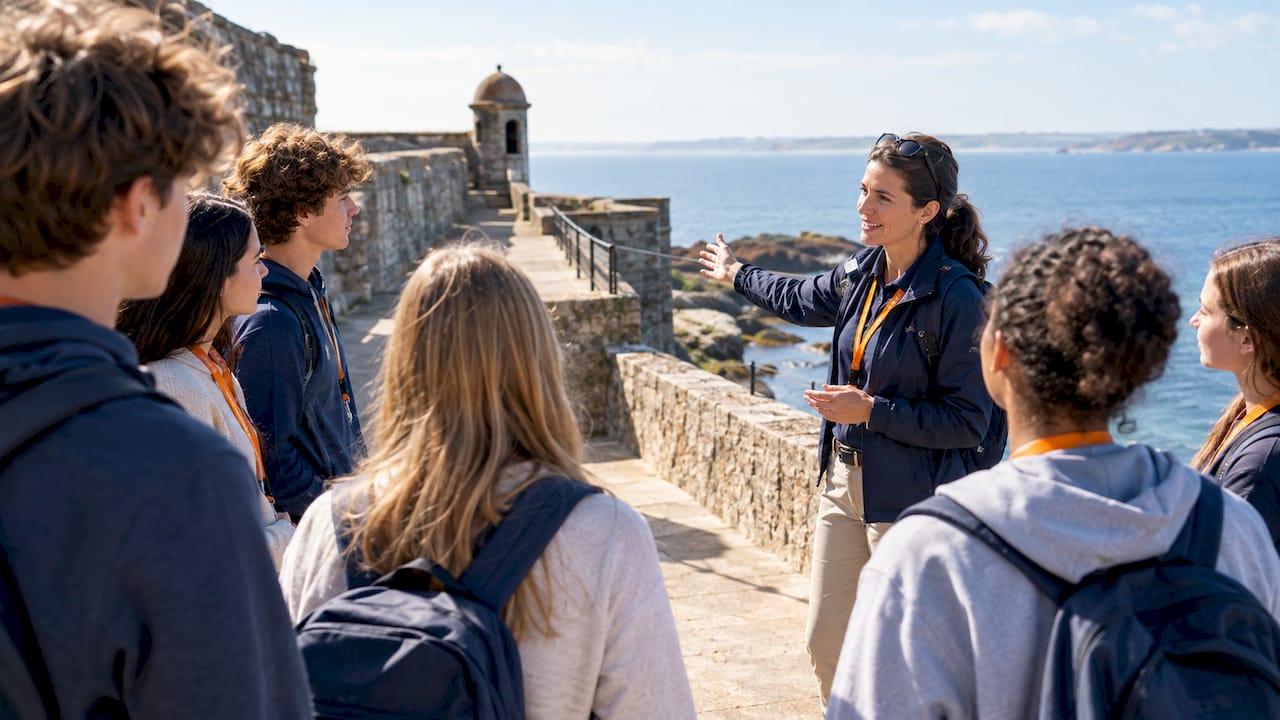
Once the group is traveling, the work shifts to daily execution: hotel safety orientations, defined meeting points, nightly staff briefings, and immediate response to medical or behavioral incidents as they happen. SYTA’s safety guidance frames student travel safety around these same three phases and recommends formal crisis plans, hotel orientations, and staff briefings as standard practice, not optional extras.
After the trip ends, the job isn’t done. Post-trip work includes:
- Filing incident reports for anything that happened, however minor
- Sending follow-up communications to families about health or behavioral events
- Running a leader debrief to capture what worked and what didn’t
- Archiving documentation in case of later insurance or legal questions
Schools that treat post-trip reporting as a formality tend to repeat the same mistakes on the next trip. A short internal resource, like our step-by-step school trip guide, can help standardize what that debrief actually captures.
Who’s in charge: the on-site coordinator or the group leader?
Confusion about who does what during a crisis wastes precious minutes. The University of Hartford’s emergency response protocol describes a dual-layer model that applies well beyond university programs: an on-site leader handles the immediate in-country response while a separate team manages notifications, logistics, and family communications from home.
Applied to a school or performance trip, the division generally looks like this:
- The on-site coordinator manages the immediate scene: securing the group, assessing the situation, and making first-response decisions.
- The primary group leader confirms student welfare, communicates with the coordinator, and retains final legal responsibility for the group.
- A home-office or family liaison handles outbound communication to parents and administrators, so the people on the ground aren’t also fielding forty phone calls.
Even with a dedicated coordinator on-site, the group leader is expected to review the vendor’s emergency procedures beforehand and keep a copy of the plan accessible throughout the trip, per the Hartford protocol. Support augments the leader’s capability. It never replaces the leader’s accountability.
Pro Tip: Print a one-page chain-of-command card for every chaperone, listing who calls whom and in what order.
What to do first when an incident happens on-site
A clear sequence beats improvisation every time, and rehearsed steps save time exactly when time matters most.
- Secure the group and take a headcount to confirm everyone is accounted for.
- Assign immediate roles: someone escorts the affected student, someone manages communications, someone supervises the rest of the group at a designated meeting point.
- Follow the contact sequence: local emergency services first, then the on-site coordinator or crisis team, then the home office and family liaison.
- Document the incident in detail, open an insurance or medical claim if warranted, and plan what families will be told and when.
SYTA’s preparedness materials describe a crisis coordination model built around a designated “Go Team” that handles on-ground logistics so the primary leader can stay focused on students rather than juggling calls. A pre-established hierarchy, rather than reliance on whoever’s phone has signal, is what experienced coordinators point to as the difference between a contained incident and a chaotic one.
Building on-site support into your emergency operations plan
An emergency operations plan (EOP) that never mentions field trips or vendor support is a plan with a blind spot. The Ed recommends adding a field trip or study-abroad annex to the school’s EOP, built with a multidisciplinary planning team rather than a single administrator working alone.
That annex should reference the vendor’s own crisis plan and contact procedures directly, so nobody is hunting for a phone number during an actual emergency. Before approving a vendor for student travel, schools typically request:
- A documented crisis response plan covering pre-trip, trip, and post-trip phases
- Proof of staff background checks
- Confirmation of insurance coverage and limits
- Evidence of staff training credentials, including first-aid or CPR certification
REMS also recommends tabletop drills and regular plan reviews to make sure the vendor relationship works in practice, not just on paper. Our pre-trip orientation guide offers a starting template for schools building this out for the first time.
How to vet an on-site trip support provider before you sign
Not every provider that calls itself a “trip coordinator” service operates at the same level, so ask direct questions before committing.
Start with credentials: does the provider maintain a documented crisis response plan across all three trip phases, run background checks on staff, and require first-aid or CPR training? Move to operational capability: is there 24/7 reachback support, a defined family liaison process, established local vendor relationships at the destination, and prior experience managing an evacuation if one becomes necessary?
Contract terms matter just as much as capability. Ask about staff-to-student ratios, insurance coverage limits, and what happens contractually if the trip is canceled or disrupted partway through. SYTA notes that school districts increasingly require proof of a vendor’s crisis plan before approving contracted student travel, so having that documentation ready in writing speeds up approval rather than slowing it down.
Pro Tip: Ask a provider to walk you through one real incident scenario end to end. How they answer tells you more than any brochure.
For 24/7 support models and communications coordination during evacuations, AD VERBUM’s travel and hospitality resources offer useful industry context on how operators structure round-the-clock response.
Quick-reference safety checklist for performance days and venue visits
Print this and hand it to every chaperone before doors open.
- Designate meeting points at every venue, hotel floor, and transportation stop.
- Run room checks and enforce a buddy system for any unsupervised time.
- Set clear rules for pool areas and any group transportation.
- Require staff check-ins at fixed intervals and hold a nightly briefing to flag issues.
- Report any separation or incident immediately, not at the end of the day.
Each traveler’s emergency card should include a photo, allergy and medication information, an emergency contact number, and the on-site coordinator’s number. Nightly briefings and rehearsed drills, according to SYTA’s student travel safety guide, materially reduce separation incidents and speed up reunification when a student does get separated from the group.
Why professional on-site support changes how a trip actually runs
Watching how trips run with dedicated on-site support versus without one, the pattern is consistent: fewer interruptions pulling the lead chaperone away from students, clearer and faster communication with families when something happens, and incidents that get resolved in minutes instead of dragging into an afternoon of confused phone calls. Some organizations supply dedicated trip coordinators and the documentation schools need to satisfy their own emergency operations plans. The gap between a good trip and a bad one is rarely the destination. It’s almost always the response when something unplanned happens.
— Donovan
Let Group Travel Network handle the on-site details
Planning a performance tour or an educational trip means juggling a hundred small risks at once, and you shouldn’t have to be the only person catching them. Some providers build this into their work: dedicated trip coordinators, online registration, flexible payment plans, and travel protection options on every trip booked.

If you’re weighing whether to add professional on-site support to your next trip, ask us for a sample crisis response plan or talk directly with a trip coordinator about your itinerary. Explore our Performance Tours or Educational Endeavors pages, or start at Grouptravelnetwork to get a plan built around your group.
Where to find the source guidance and templates
For readers who want to go straight to primary documentation: SYTA’s safety guides cover pre-trip, trip, and post-trip best practices. The University of Hartford protocol details on-site leader responsibilities. REMS/ED.gov offers EOP annex guidance, and CDC/Safe Supportive Learning provides student health guidance for travel.
Sources
- SYTA safety guides and student travel resources
- University of Hartford — emergency response protocol for international programs
- REMS: Building Blocks to School Safety (EOP guidance)
- Advice for safe and healthy travel for students (CDC / SSLE)
FAQ
What does on-site trip support typically cost?
Pricing varies by provider, group size, and destination, and most companies quote it as part of an overall trip package rather than a separate line item. Contact a provider directly for a quote tied to your specific itinerary.
Does hiring on-site support remove liability from the school?
No. The group leader and school retain final legal responsibility for the group even when a vendor provides on-site coordination, according to the University of Hartford’s emergency protocol. On-site support adds capability during a crisis, but it does not transfer duty of care away from the school.
When should a school require on-site trip support?
Any trip involving overnight travel, an unfamiliar destination, or a large group benefits from dedicated on-site coordination, particularly for performance tours and international trips where logistics multiply quickly. Many districts now require proof of a vendor’s documented crisis plan before approving travel at all.
How are families notified during a travel emergency?
Family notification typically runs through a designated liaison who works separately from the on-site team handling the immediate incident, so communication stays clear rather than duplicated or contradictory. This separation of roles is a core part of the dual-layer emergency response model used in most structured travel programs.
What training should on-site trip support staff have?
At minimum, staff should hold current first-aid and CPR certification and be trained on the provider’s documented crisis response plan across pre-trip, trip, and post-trip phases. Schools can request proof of these credentials, along with background check documentation, before approving a vendor for student travel.
Recommended

Relax with our Student Travel Expertise .
We deliver stress-free student trips backed by an exceptional array of services you won’t find anywhere else:
- Stress-free, creative planning of customized itineraries
- Dedicated GTN Service host on every trip
- Extensive travel protection plan options
- Online, individual registration system
- Flexible payment plans and online payment options
- Bulk buyer discounts for great trips that cost less
Inclusion into #MyGTNFamily for life! (you don’t even have to remember our birthday!)
Spain
There is no place like Spain to offer a student performance opportunity or cultural student trip.
Myrtle Beach
All students love the beach! Especially a beach known for its 60 miles of pristine coastline.
Boston
Have your students experience colonial charm in the city that is considered the hub of New England.
London
Provide your student group with the “Royal” treatment! One of the world’s most recognized cities.
See What People Are Saying
“This was my first time using a company to plan our band trip. It was so easy working with Justin and Group Travel Network. We had to make several changes along the way, but they were accommodating changes and worked everything out for us. I would highly recommend using Group Travel Network.”
“It has been my privilege to use Group Travel Network as the exclusive travel coordinator for my band for over 10 years. I can say, without doubt or hesitation, that GTN is, by far, the best travel company for student groups currently in existence. I have often said that I wouldn’t take my band across the street without GTN and that’s not far from the truth!”
“What wonderful trip we had to NYC! Our group of 51 never missed a beat because of Group Travel Network and our wonderful guide, Tim. It was truly a theatre trip to remember! If you are looking for a travel company who really cares about the details, Group Travel Network is for you!”