

September 8, 2026
U.S. Parents: 6–8 Week Plan for Minors’ International Travel Documents

Every U.S. minor traveling internationally needs a valid passport, proof of parentage or citizenship, and, in many cases, a notarized parental consent letter. The United States does not require an exit permission form, but plenty of destination countries, transit hubs, and even individual airlines do require notarized consent when a child travels without both custodial parents. Check the embassy page and airline policy for every country on your itinerary before you book anything.
TL;DR:
- Minors traveling internationally must carry a valid passport, proof of citizenship, and a notarized consent letter if traveling without both parents.
- A notarized consent letter must include full names, travel details, passport numbers, and a reachable phone number, with notarization valid for 90 days.
- Different transit countries and airlines may impose separate documentation requirements, making thorough route-specific checks essential before booking.
- Starting preparations at least eight weeks before departure, including applying for passports and gathering all documents, helps prevent last-minute travel issues.
Table of Contents
- What Documents Does a Minor Need for International Travel?
- Getting a Passport for Your Minor: Fees, Timelines, and Fine Print
- How Do You Write a Valid Parental Consent Letter?
- Who Proves Custody, Parentage, or Guardianship?
- Do Transit Countries and Airlines Have Their Own Rules?
- How Do School and Group Trip Organizers Manage Minors’ Paperwork?
- What’s the 6 to 8 Week Timeline Before Departure?
- How Do You Renew an Expired Minor Passport?
- Can a Minor Use an Enhanced Driver’s License or Global Entry Instead of a Passport?
- What Should You Do in a Travel Emergency Involving a Minor?
- Three Mistakes I See Parents Make Over and Over
- How Group Travel Network Helps Schools Handle Minor Travel Paperwork
- Sources
- FAQ
What Documents Does a Minor Need for International Travel?
Print this list and check items off as you gather them. Missing even one piece can mean a denied boarding pass at the gate, not just a headache at customs.
- Passport book (required for nearly all international air travel; the passport card only works for limited land and sea crossings)
- Original certified birth certificate or other proof of citizenship, even after the passport is issued
- Notarized consent letter or Form DS-3053 when the child is traveling without one or both parents
- Custody orders, adoption decree, or guardianship paperwork, if applicable to your family situation
- Photo ID for the accompanying adult, plus photocopies of every document above
- Digital backups stored in a shared folder, and a check of the specific airline’s minor-travel forms
Airlines vary widely on this last point. Some carriers require nothing extra for a two-parent family trip; others ask for a signed form the moment a child boards with just one parent or a non-parent adult.
Getting a Passport for Your Minor: Fees, Timelines, and Fine Print
Every U.S. citizen child under 16 needs their own passport for international travel, and there’s no shortcut around the paperwork. Children cannot apply online or by mail. A parent or guardian must complete Form DS-11 in person at a passport acceptance facility or passport agency, with the child present.
Fee snapshot: a child’s passport book costs $100 for the application fee plus a $35 facility acceptance fee, a total most parents don’t budget for until they’re standing at the counter.
Here’s the process, start to finish:
- Gather original evidence of U.S. citizenship: a certified birth certificate, Consular Report of Birth Abroad, Certificate of Citizenship, or a previous full-validity passport.
- Bring a valid photo ID for each parent and one photocopy of that ID.
- Complete Form DS-11 (don’t sign it until the acceptance agent tells you to).
- Submit in person with your child, pay the fees, and ask about processing speed.
- Choose expedited service if travel is coming up fast. Routine processing takes longer than most families expect, so build in a buffer.
Pro Tip: Scan every document (birth certificate, both parents’ IDs, the finished DS-11) before your appointment. If the facility flags a problem, you’ll have a backup on your phone instead of driving home to grab the original.
Double check your destination’s passport validity rule too. Many countries require at least six months of remaining validity beyond your travel dates, which matters a lot for a document that expires every five years for minors.
How Do You Write a Valid Parental Consent Letter?
A notarized consent letter is the single most misunderstood document on this list. It isn’t legally required by the U.S. government for domestic exit, but USA.gov explicitly recommends one whenever a child travels without both custodial parents, and many foreign governments treat it as a hard requirement at the border.
A solid consent letter includes:
- Full legal names of the child, both parents or legal guardians, and the accompanying adult
- Exact travel dates and destination(s), including transit stops
- Passport numbers for the traveling child and the accompanying adult
- A clear statement granting permission for the trip, plus a phone number where the consenting parent can be reached
When a parent can’t be present for the passport application itself, that’s where Form DS-3053 comes in. It has to be notarized, and the notarization is only good for 90 days, so timing matters. Sign it too early relative to your travel dates and you may need to redo it.
Notarization can happen at any U.S. notary, or at a U.S. embassy or consulate if the absent parent is overseas. Some states allow electronic notarization, but the State Department requires a printed copy at the time of application. Keep the letter in English, add a certified translation if your destination requests one, and travel with the original plus copies.
Who Proves Custody, Parentage, or Guardianship?
Officials ask for proof of the adult-child relationship for a reason that has nothing to do with bureaucracy for its own sake: it’s a front-line defense against international parental child abduction, and the State Department is direct about that purpose.
What to carry depends on your family’s situation:
- Two-parent families: an original certified birth certificate showing both parents’ names usually covers it.
- Adoptive families: bring the adoption decree in addition to the birth certificate, since names sometimes don’t match cleanly.
- Sole custody: carry the custody order itself, not just a summary, and be ready to show it at check-in and at the border.
- One parent unavailable: the notarized DS-3053, an embassy notarization if abroad, or a notarized affidavit explaining the extraordinary circumstance.
- Complex situations (contested custody, protective orders, a parent barred from international travel with the child): loop in a family-law attorney well before you book flights.
Do Transit Countries and Airlines Have Their Own Rules?
Yes, and this trips up more families than expired passports do. A layover country can enforce its own entry and transit rules completely independent of your final destination’s requirements, so a consent letter that satisfies France won’t automatically satisfy a connection through the United Arab Emirates.
The number that surprises most parents: there’s no single universal standard. Each country sets its own minor-travel documentation rules, which is why the U.S. embassy guidance on DS-3053 stresses verifying requirements country by country rather than relying on a general rule of thumb.
Work through this order before you finalize any itinerary:
- Check the final destination country’s official entry requirements or embassy page.
- Check every transit country separately, even for a two-hour layover.
- Call the airline directly and ask about minor-consent forms; FAA guidance confirms that carriers can set their own boarding rules on top of government requirements.
- Prepare English originals and copies, plus a certified translation if any country on the route requests one.
How Do School and Group Trip Organizers Manage Minors’ Paperwork?
Group trips multiply the documentation problem by every traveler on the roster, which is exactly why schools and performance groups need a centralized system instead of trusting each family to sort it out independently.
A solid group travel document packet includes each student’s passport, certified birth certificate, signed consent letter, and any required medical forms, collected well ahead of departure rather than the week before. Coordinators who batch notarization appointments and scan every document into a secure shared drive avoid the scramble that hits disorganized groups at the airport. Online registration portals also catch missing paperwork automatically, flagging a family who hasn’t uploaded a birth certificate before it becomes a boarding-gate crisis. Group Travel Network’s consent-form field guide and pre-travel document checklist give organizers a ready-made template instead of building one from scratch.

What’s the 6 to 8 Week Timeline Before Departure?
Work backward from your departure date using this rough sequence:
- 8 weeks out: apply for or renew the passport if it’s expired, expiring soon, or doesn’t meet the destination’s validity window.
- 6 weeks out: draft the consent letter; if you need DS-3053, time the notarization so the 90-day window covers your actual travel dates.
- 4 weeks out: make physical and digital copies, and send scans to trip coordinators or trusted adults staying behind.
- 3 weeks out: enroll your child in the Children’s Passport Issuance Alert Program and register higher-risk trips with the destination’s U.S. embassy.
- 1 to 2 weeks out: confirm final details with the embassy, airline, and passport acceptance facility.
How Do You Renew an Expired Minor Passport?
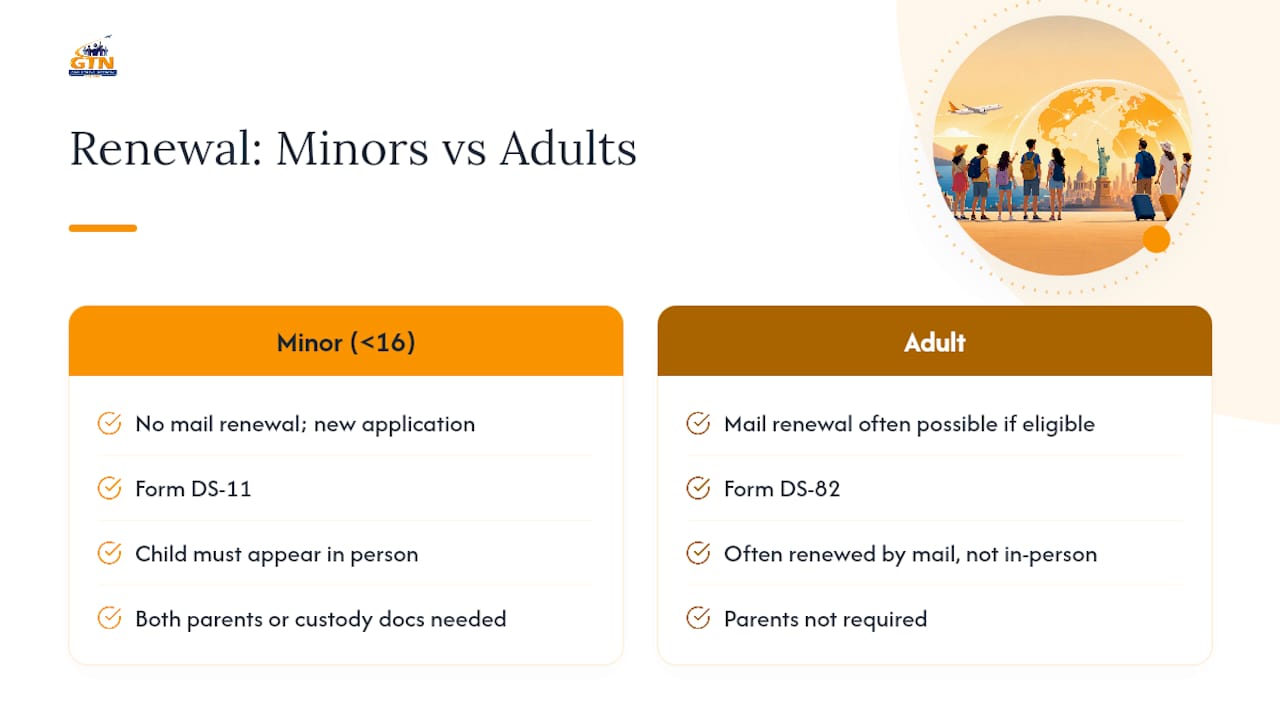
Renewal for a minor isn’t actually a renewal in the adult sense. Every U.S. minor passport, whether it’s the first one or the fifth, requires an in-person appointment with Form DS-11, because the government treats every application for a child under 16 as a new application rather than a mail-in renewal.
That’s the biggest difference from adult passports: adults with a passport issued within the last 15 years can often renew by mail using Form DS-82. Minors never qualify for that shortcut, regardless of how recently their last passport was issued. The child must appear in person, both parents (or documented sole custody) generally need to be part of the process, and you’ll need the expired passport itself as one piece of evidence, alongside the birth certificate and photo ID requirements covered earlier.
Fees are the same as a first-time application: $100 for the passport book plus the $35 facility fee at an acceptance facility. Processing timelines also work the same way, so if your child’s passport expired and you have international travel booked, treat it with the same urgency as a first application. Don’t assume renewal is faster just because the child has traveled before.
One planning detail worth flagging: minor passports issued to children under 16 are valid for five years, versus ten years for adults. That shorter cycle means families with several school-age kids often find themselves juggling two or three renewal dates within the same few years, which is exactly why building the passport check into your 6 to 8 week pre-trip timeline (covered above) saves you from discovering an expired passport during check-in.
Can a Minor Use an Enhanced Driver’s License or Global Entry Instead of a Passport?
For international air travel, no other document substitutes for a passport. An enhanced driver’s license works for certain land and sea border crossings into Canada, Mexico, and some Caribbean destinations, but it isn’t accepted for flights, and airlines will turn a family away at check-in if a passport is expected and a license shows up instead.
Global Entry membership speeds up re-entry into the United States after international travel, letting members skip the standard customs line at kiosks in major airports. It’s a convenience layer, not a substitute for a passport, and minors need their own membership, which requires the same underlying citizenship documents as a passport application. A passport card is a cheaper alternative to the passport book but only works for specific land and sea crossings, never for flights, so most families traveling by air should stick with the full passport book covered earlier in this guide.
Enrollment in the Children’s Passport Issuance Alert Program is worth mentioning again here because parents sometimes confuse it with a travel document. It isn’t one. It’s a notification system that alerts an enrolled parent if someone applies for a new passport in their child’s name, which matters most for separated or divorced parents concerned about unauthorized travel.
What Should You Do in a Travel Emergency Involving a Minor?
Emergencies don’t wait for the 8 week timeline, so here’s the compressed version.
Urgent passport need: If your child has no valid passport and travel is days away, go straight to a regional passport agency (appointment required) rather than a standard acceptance facility, and request expedited or life-or-death emergency service if the situation qualifies. Bring every document listed in the earlier passport section, plus proof of imminent travel like a flight confirmation.
Sudden need for consent documentation: If a parent becomes suddenly unavailable, a notarized affidavit explaining the circumstance, combined with Form DS-3053 where applicable, can often be arranged same-day through a local notary or, if the parent is abroad, through a U.S. embassy or consulate. Keep in mind the 90-day notarization window still applies, so don’t notarize far in advance of actual need.
Lost or stolen documents abroad: Contact the nearest U.S. embassy or consulate immediately; they can issue emergency passport documents for return travel even without every original piece of paperwork, though it takes coordination.
Suspected abduction risk: Parents with any concern about unauthorized international travel should contact the Office of Children’s Issues before a trip is booked, not after a child has already left the country.
Three Mistakes I See Parents Make Over and Over
The expired passport catches families every single time, usually because nobody checks the five-year minor cycle until they’re at the airport. Missing notarized consent is the second, especially with blended or divided families who assume a birth certificate alone will cover it. The third is transit-country blindness: parents research the destination thoroughly and never glance at the layover country’s own rules.
One habit fixes most of this: start your document checklist eight weeks out, and keep every scan in one shared folder the whole family can access. Confirm airline and embassy requirements again in the final 7 to 14 days, because rules do change.
— Donovan
How Group Travel Network Helps Schools Handle Minor Travel Paperwork
Some group travel coordinators give school administrators, band directors, and youth organizers a single point of control instead of chasing dozens of families for passports and consent letters one email at a time, offering helpful resources like common Spanish phrases for travel to ease communication in Spanish-speaking countries.

Dedicated trip coordinators review every student’s documents against the destination’s actual entry rules, and the online registration portal flags a missing birth certificate or unsigned consent form before it becomes a departure-day emergency. That verification step, paired with flexible payment plans and travel protection options, is what separates a group trip that runs smoothly from one where a chaperone is arguing with a gate agent at 5 AM. If your school or organization is planning an international student trip, the student educational travel guide walks through how the process works, and you can request a quote to see how document coordination fits into your itinerary.
Sources
FAQ
What documents does a minor need to fly internationally?
A valid U.S. passport, proof of citizenship such as a certified birth certificate, and a notarized consent letter if the child isn’t traveling with both custodial parents.
What documents do I need to allow my minor child to travel outside the United States?
You’ll want the child’s passport, a notarized consent letter (or Form DS-3053 if a parent can’t appear for the passport application), and any custody or guardianship paperwork relevant to your family.
What documents does a minor need to travel to the USA with only one parent?
A valid passport plus, in many cases, a notarized letter from the absent parent granting permission, along with any custody documentation if the parents are separated or divorced.
What documents does a child need to travel to the USA?
U.S. citizen children need their own valid passport; children of other nationalities need their passport plus whatever visa their home country requires, along with proof of their relationship to the accompanying adult.
Recommended

Relax with our Student Travel Expertise .
We deliver stress-free student trips backed by an exceptional array of services you won’t find anywhere else:
- Stress-free, creative planning of customized itineraries
- Dedicated GTN Service host on every trip
- Extensive travel protection plan options
- Online, individual registration system
- Flexible payment plans and online payment options
- Bulk buyer discounts for great trips that cost less
Inclusion into #MyGTNFamily for life! (you don’t even have to remember our birthday!)
Spain
There is no place like Spain to offer a student performance opportunity or cultural student trip.
Myrtle Beach
All students love the beach! Especially a beach known for its 60 miles of pristine coastline.
Boston
Have your students experience colonial charm in the city that is considered the hub of New England.
London
Provide your student group with the “Royal” treatment! One of the world’s most recognized cities.
See What People Are Saying
“What wonderful trip we had to NYC! Our group of 51 never missed a beat because of Group Travel Network and our wonderful guide, Tim. It was truly a theatre trip to remember! If you are looking for a travel company who really cares about the details, Group Travel Network is for you!”
“This was my first time using a company to plan our band trip. It was so easy working with Justin and Group Travel Network. We had to make several changes along the way, but they were accommodating changes and worked everything out for us. I would highly recommend using Group Travel Network.”
“It has been my privilege to use Group Travel Network as the exclusive travel coordinator for my band for over 10 years. I can say, without doubt or hesitation, that GTN is, by far, the best travel company for student groups currently in existence. I have often said that I wouldn’t take my band across the street without GTN and that’s not far from the truth!”