

September 27, 2026
90 Day Band Performance Tour Playbook for School Directors

Plan the tour as a single logistics and education operation: set dates, confirm your roster, open a trip account, and follow the T-90 to post-tour checklist below. Band performance tour planning fails most often when scheduling, budgeting, and safety are treated as separate jobs handled by separate people. Build one timeline, assign one owner per task, and the rest of the plan follows.
TL;DR:
- Confirm all venue advances and agreements in writing at least 10 to 14 days before the performance date to prevent last-minute issues.
- Limit consecutive drive times between performance locations to 300 miles or four to five hours to maintain schedule integrity and rehearsal quality.
- Build a contingency fund based on a percentage of total trip costs to cover weather delays, mechanical failures, or medical emergencies.
- Use a dedicated trip coordinator or online systems to handle advancing, contracts, and payments, reducing the workload on school staff.
- Conduct nightly reconciliations and document all expenses promptly to ensure accurate post-tour financial closure and rebooking opportunities.
Table of Contents
- Your T-90 to post-tour planning timeline
- How to budget and fundraise for the tour
- Routing and drive-time limits that protect the music
- Advancing each date: what to confirm in writing
- Keeping instruments and equipment safe on the road
- Safety, supervision, and emergency planning for student tours
- Designing an itinerary that teaches as much as it performs
- Who does what: roles, documents, and communication tools
- Closing out finances and turning the tour into a rebooking
- How Group Travel Network supports this checklist
- What the checklist gets right, and where directors overcorrect
- Let a dedicated coordinator carry the logistics
- Sources
- FAQ
Your T-90 to post-tour planning timeline
Treat the calendar as a chain of dependent tasks rather than a list of deadlines. Professional touring works because routing, timing, and production are managed as one operation instead of isolated silos, and the same discipline applies to a school band performance tour. Group Travel Network’s own planning guidance recommends finishing inventories and operational handbooks early, using an “end in mind” approach so students and chaperones aren’t guessing on travel day, a habit borrowed from its band trip planning guide.
T-90 to T-60 (three months out):
- Finalize dates and confirm the traveling roster with a hard deadline for opt-outs.
- Sketch a rough route between target performance cities or venues.
- Open a trip account or deposit schedule and set a budget float for contingencies.
- Prepare or update the ensemble’s electronic press kit (EPK) for venue and festival outreach.
- Place holds on lodging, transportation, and performance dates before they lock in.
T-60 to T-30 (two months out):
- Convert soft holds into signed contracts for lodging, transportation, and venues.
- Lock final lodging headcounts and room configurations.
- Order uniforms, programs, or tour merchandise with enough lead time for reprints.
- Assign trip roles in writing: trip leader, chaperones, instrument manager, and medic contact.
T-30 to T-7 (final month):
- Advance every date in writing, confirming load-in, soundcheck, and settlement terms.
- Distribute day sheets to chaperones, drivers, and section leaders.
- Run a full rehearsal that mirrors the actual performance schedule, including instrument load-out timing.
Tour week and post-tour:
- Hold a short daily check-in with chaperones and drivers before departure each morning.
- Keep a nightly log of expenses, incidents, and schedule deviations.
- Reconcile all accounts within a week of returning.
- Reach out to venues and hosts about rebooking while the visit is still fresh in their minds.
A T-90 to post-tour checklist, paired with nightly settlements and written advances, prevents the majority of the failures that derail school tours: missed load-ins, lodging mismatches, and budget surprises that surface only after the buses are already loaded.
How to budget and fundraise for the tour
A realistic budget has more line items than most directors expect, and the ones that get forgotten are usually the ones that sink a trip financially.
- Transportation: charter or bus rental, fuel, tolls, and parking.
- Lodging: room blocks, resort fees, and any required deposits.
- Meals: per diems for students and chaperones, plus group meal reservations.
- Performance costs: venue fees, backline rental, and insurance riders.
- Often-forgotten lines: instrument repair kits, reed and string replacement, laundry service on multi-day trips, and credit card or payment-processing fees.
- Contingency fund: a fixed percentage held back for weather delays, mechanical breakdowns, or medical needs.
Model three scenarios before you commit to a budget: a best case with full enrollment and no surprises, a realistic case with typical attrition and minor delays, and a worst case with a canceled date or a mechanical failure. Set your float, the cash reserve you keep untouched until needed, based on the worst case, not the best one. A tour that only survives if everything goes right isn’t actually funded.
For payment collection, set a clear cadence: a nonrefundable deposit at booking, a second payment at the midpoint, and a final balance due no later than T-30. Online registration systems make this easier to track than spreadsheets and paper checks, since families can see their own balance and deadlines without calling the office. A dedicated trip-account platform or student-activity registration tool, such as Vivaky, can centralize payments and permissions, though directors outside its home market should confirm compatibility with their district’s payment processor before adopting it.
Pro Tip: Build your contingency line as a percentage of total trip cost, not a flat dollar amount. That way it scales automatically as your roster or itinerary grows.
Routing and drive-time limits that protect the music
Route design is where a lot of tours quietly lose quality before a single note is played. Industry routing practice caps consecutive drives between performance dates at roughly 300 miles, or about 4 to 5 hours, to keep load-in, soundcheck, and rest on schedule.
300 miles or 4 to 5 hours is the practical ceiling most professional tour routing guidance recommends between performance dates, and it holds for school tours too: beyond that window, soundcheck time and rehearsal quality both start to slip.
- Build the itinerary around anchor rooms, home base hotels you return to for two or three nights, rather than moving lodging every single night.
- Sequence dates geographically instead of chasing the best-sounding venue regardless of location, which invites costly backtracking.
- Size your vehicle fleet to the instrument and equipment load, not just headcount, since brass and percussion sections often need a separate truck.
- Confirm parking and loading-dock access at every venue before the date is finalized, since dock size and dock hours often dictate arrival time more than distance does.
- Plan overnight moves only when a next-day performance window requires it, and build in driver rest according to standard hours-of-service practices.
Professional logistics operations route around load-in windows and dock access first, then fit driving time around those windows rather than the other way around, a sequencing habit worth borrowing even for a five-date regional trip.
Advancing each date: what to confirm in writing
Advancing is the single habit most likely to separate a smooth tour from a chaotic one: confirming every technical and financial detail with a venue before you arrive, so nothing gets negotiated on load-in day.
Advance checklist to confirm with every venue:
- Date, arrival time, and performance set length.
- Load-in and soundcheck windows, with buffer time built in.
- Backline provided by the venue versus what you’re bringing.
- Hospitality arrangements for students and chaperones.
- Settlement terms: who pays whom, when, and in what form.
- A named local contact with a working phone number.
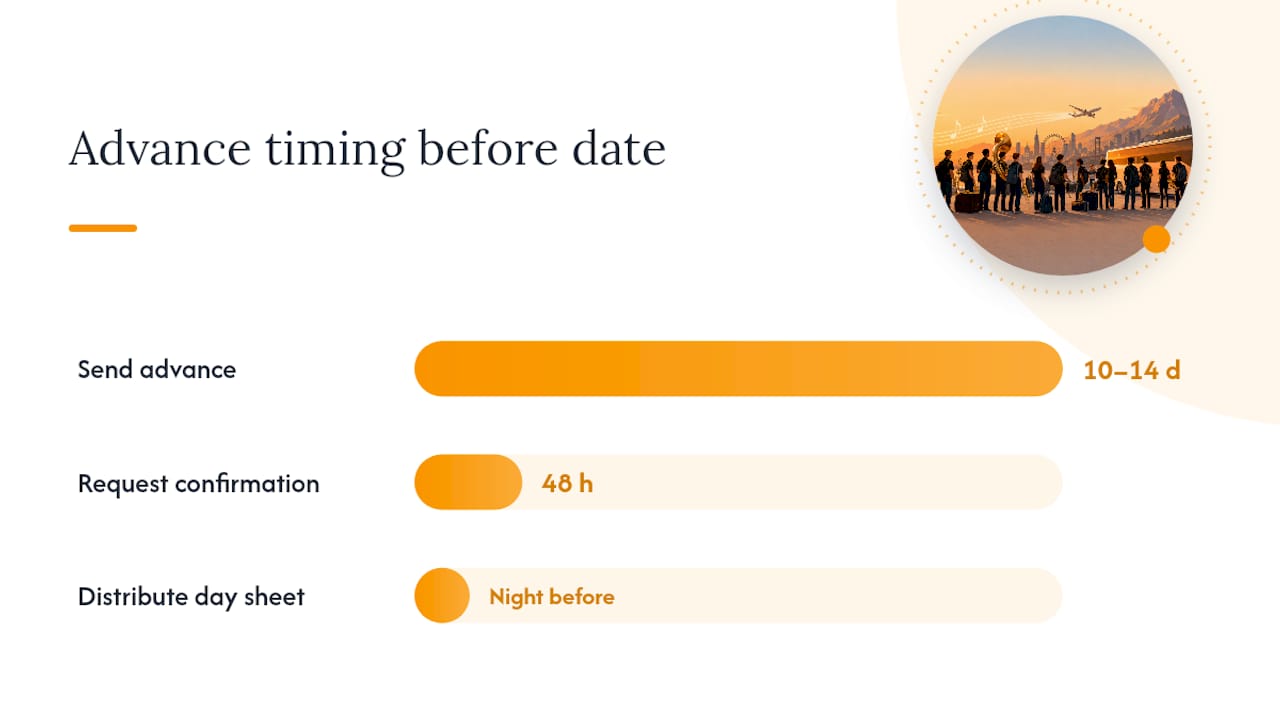
- Send the advance 10 to 14 days before the date, in writing, not just by phone.
- Request written confirmation within 48 hours and follow up if it doesn’t arrive.
- Save every email or message thread in a shared folder your trip leader can access on the road.
A one-page day sheet built from this checklist, listing arrival time, load-in, soundcheck, performance time, and load-out, should go to every chaperone and driver the night before, not the morning of. A basic stage plot and input list, even for a school ensemble without a sound engineer, saves real time at soundcheck and avoids confusion with house crews who are meeting your group for the first time.
Keeping instruments and equipment safe on the road
Instrument damage and last-minute rentals are two of the most preventable problems on a school tour, and both come down to inventory discipline.
- Create a numbered inventory of every instrument, case, and piece of equipment before departure, with a matching label on each case.
- Decide in advance what stays with students overnight versus what gets locked in a truck or venue storage room.
- Consider a dedicated instrument truck for larger ensembles rather than relying on bus undercarriage storage, which limits access and increases damage risk.
- Carry proof of insurance coverage and a copy of each policy’s claims process, since a damaged instrument on the road needs documentation immediately, not after you’re home.
- Decide what’s worth renting locally, larger percussion or amps, versus what must travel with the group, such as personal woodwinds and brass.
Load-in priority matters more than most directors plan for: get percussion and heavy gear off the truck first so it’s set up before soundcheck, and load personal instruments last so students aren’t standing around holding them during setup.
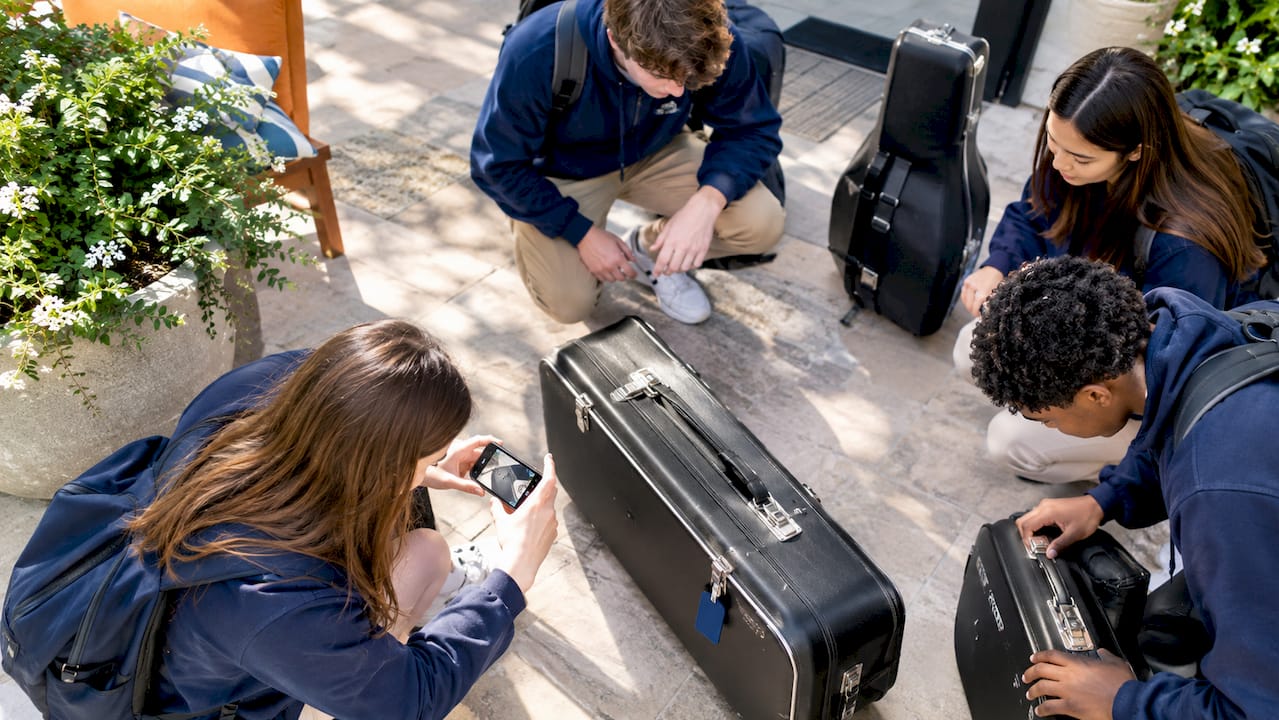
Pro Tip: Photograph every instrument case before departure and after arrival at each venue. It takes two minutes and settles most damage disputes on the spot.
Safety, supervision, and emergency planning for student tours
Duty of care is not a formality on a student tour, it’s the framework everything else depends on. Set supervision ratios before you finalize the roster, not after, and make sure every chaperone has a copy of medical forms, medication logs, and an emergency contact list for their assigned group.
- Assign one chaperone per small group of students, with ratios adjusted for age and trip complexity.
- Collect medical forms and medication authorizations for every traveling student well before departure.
- Distribute a printed and digital emergency contact list to every adult on the trip, not just the trip leader.
- Run a short contingency drill before departure: what happens if a student is lost, ill, or the bus breaks down.
For any trip that crosses international borders, K-12 emergency planning guidance recommends building a dedicated Study Abroad or International Travel Annex into your school’s emergency operations plan, one that lists embassy and consulate contacts, enrollment in the Department of State’s Smart Traveler Enrollment Program, local emergency services, and a clear family-reunification plan.
An EOP international travel annex should include embassy and consulate contacts, STEP enrollment, local emergency services, family-reunification steps, and a clear chain of command.
U.S. Department of Education emergency planning guidance
On-trip communications should be simple enough that a tired chaperone can use them at 11 p.m.: one group messaging thread for logistics, one direct line to the trip leader for emergencies, and a printed contact sheet as backup when phones die or signal drops.
Designing an itinerary that teaches as much as it performs
A performance tour earns its place in the curriculum when every stop has a stated learning objective, not just a slot on the schedule. Before you finalize dates, write down what students should be able to do or understand after each performance or cultural visit, then check that the itinerary actually supports it.
- Tie each performance to a specific rehearsal goal, such as dynamic control in a resonant hall versus a gym.
- Pair cultural or historical visits with a short reflection prompt students complete the same day, while details are fresh.
- Schedule genuine downtime, not just travel time, since fatigued students perform and behave worse.
A workable day template looks like this: sleep, drive, load-in, soundcheck, set, load-out, sleep. Building the schedule around that sequence, rather than cramming sightseeing between soundcheck and set, keeps both the music and the students in better shape by the final date.
Back at school, a short post-performance reflection assignment or a recorded debrief session turns the trip into something gradeable, not just memorable, and gives directors material for next year’s curriculum-aligned planning.
Who does what: roles, documents, and communication tools
Clear roles prevent the two most common on-tour breakdowns: nobody owning a problem, and two people trying to solve the same one.
- Trip leader: owns the schedule, advances, and final decisions on the road.
- Chaperones: own their assigned student group’s safety, medication, and check-ins.
- Instrument manager: owns inventory, loading sequence, and damage documentation.
- Merch and settlement contact: owns cash handling, sales tracking, and venue payouts.
- Medic contact: owns medical forms, medication logs, and first-response coordination.
Core documents worth building once and reusing every tour: a master contact list, day sheets for each date, a routing sheet with drive times, and a settlement log tracking what was paid, to whom, and when. Simple registration and messaging tools keep these centralized instead of scattered across group texts and paper folders, which matters more on a ten-date tour than a two-day trip.
Closing out finances and turning the tour into a rebooking
The tour isn’t finished when the last note is played. A clean close protects next year’s budget and your relationship with every venue you visited.
- Complete a nightly reconciliation, or z-out, of cash and card transactions at each stop rather than waiting until you’re home.
- Categorize every expense against your original budget lines within a week of returning, while receipts and memory are still fresh.
- Retain contracts, settlement logs, and insurance documentation for at least one full budget cycle.
- Produce updated performance video, photos, and an EPK refresh for next year’s venue outreach.
- Send a short debrief to your administration covering what worked, what didn’t, and what the budget actually cost against projections.
- Reach out to venues and hosts about rebooking while your ensemble is still top of mind, and note any scheduling preferences for next year’s tour planning.
How Group Travel Network supports this checklist
Every task above can be run in-house with enough lead time and a disciplined owner for each line. Some directors choose to hand the operational load to a partner instead, particularly for first international trips or larger rosters.
- Dedicated trip coordinators handle advancing, routing, and settlement tracking so the director isn’t the single point of contact for every vendor.
- Online registration centralizes deposits, balances, and medical forms instead of spreading them across spreadsheets and paper.
- Flexible payment plans match the deposit and balance cadence outlined in the budgeting section above.
- Travel protection options add a layer of coverage on top of standard instrument and trip insurance.
Outsourcing makes the most sense when a director is managing a first international tour, a larger ensemble, or a compressed planning window. Running it in-house tends to work well for shorter regional trips where the director already has trusted local contacts.
What the checklist gets right, and where directors overcorrect
The biggest mistake in band performance tour planning isn’t underplanning, it’s overplanning the wrong things. Directors spend weeks perfecting a merchandise order and hours on a seating chart for the bus, then advance a venue with a single phone call three days before arrival. The venue call matters more.
Conventional advice treats routing as a distance problem. It’s actually a dock-access and rest-cycle problem, distance is just the easiest variable to measure. A 250-mile drive with a tight loading dock and a two-hour soundcheck window can wreck a schedule that a 300-mile drive with generous access never would.
If you take one thing from this guide, take the advancing habit. Every other system, budgeting, routing, safety, breaks down gracefully when something changes. A verbal agreement with a venue does not. Confirm it in writing, confirm it again 48 hours out, and the rest of the tour has room to bend without breaking.
— Donovan
Let a dedicated coordinator carry the logistics
Directors who read this far already know the workload is real: advancing every date, tracking nightly settlements, and keeping instrument inventories current on top of teaching a full course load. Group Travel Network’s Performance Tours service exists for the parts of this checklist that eat the most director time.

A dedicated trip coordinator takes over the advancing calls, lodging and venue contracts, and payment tracking outlined earlier in this guide, so the director’s job shifts from chasing vendors to approving decisions.
- Coordinators handle venue advances and settlement terms directly, using the same written-confirmation discipline this guide recommends.
- Online registration and flexible payment plans manage deposits and balances without spreadsheets.
- Travel protection options add coverage beyond standard instrument insurance for the trip itself.
If your ensemble is planning its first multi-city tour, or simply doesn’t have the staff hours to run advances and nightly reconciliations solo, get in touch about Performance Tours and have a coordinator build the itinerary around your rehearsal schedule instead of the other way around.
Sources
- How to route a tour efficiently — Tourbit
- How do concert tour logistics work? — Round The Clock Logistics
- Guide for Developing High-Quality School Emergency Operations Plans (Study Abroad Annex) — ERIC / U.S. Dept. of Education
- Band Tour Planning Checklist: Complete Guide — Bandmate
FAQ
How far in advance should a school band tour be planned?
Most directors should start serious planning around 90 days before departure, using a phased T-90 to post-tour timeline that locks contracts by the two-month mark and finalizes advances in the final 30 days. International trips generally need more lead time to complete emergency planning and travel documentation.
How do bands decide where to tour?
Route decisions typically balance performance opportunities against drive-time limits, since consecutive dates work best when kept to roughly 300 miles or 4 to 5 hours apart. Directors also weigh venue availability, lodging access, and whether a stop supports a specific learning or performance objective.
How much does a school band tour typically cost?
Group Travel Network does not publish set pricing for its Performance Tours service since costs depend on route, headcount, and lodging choices, so the price is available on request through a dedicated trip coordinator. Directors building their own budget should include transportation, lodging, meals, venue fees, and a contingency float on top of those core lines.
What is a nightly settlement and why does it matter on tour?
A nightly settlement, or z-out, is a same-day reconciliation of cash and card transactions and any venue payouts from that day’s performance. Doing this nightly instead of waiting until the tour ends catches errors early and keeps the final post-tour reconciliation manageable.
Do school band tours need an emergency operations plan?
Yes, and international trips specifically benefit from a Study Abroad or International Travel Annex added to the school’s existing emergency operations plan. That annex should include embassy contacts, STEP enrollment, and family-reunification steps so chaperones have a clear process if something goes wrong overseas.
Recommended

Relax with our Student Travel Expertise .
We deliver stress-free student trips backed by an exceptional array of services you won’t find anywhere else:
- Stress-free, creative planning of customized itineraries
- Dedicated GTN Service host on every trip
- Extensive travel protection plan options
- Online, individual registration system
- Flexible payment plans and online payment options
- Bulk buyer discounts for great trips that cost less
Inclusion into #MyGTNFamily for life! (you don’t even have to remember our birthday!)
Spain
There is no place like Spain to offer a student performance opportunity or cultural student trip.
Myrtle Beach
All students love the beach! Especially a beach known for its 60 miles of pristine coastline.
Boston
Have your students experience colonial charm in the city that is considered the hub of New England.
London
Provide your student group with the “Royal” treatment! One of the world’s most recognized cities.
See What People Are Saying
“What wonderful trip we had to NYC! Our group of 51 never missed a beat because of Group Travel Network and our wonderful guide, Tim. It was truly a theatre trip to remember! If you are looking for a travel company who really cares about the details, Group Travel Network is for you!”
“It has been my privilege to use Group Travel Network as the exclusive travel coordinator for my band for over 10 years. I can say, without doubt or hesitation, that GTN is, by far, the best travel company for student groups currently in existence. I have often said that I wouldn’t take my band across the street without GTN and that’s not far from the truth!”
“This was my first time using a company to plan our band trip. It was so easy working with Justin and Group Travel Network. We had to make several changes along the way, but they were accommodating changes and worked everything out for us. I would highly recommend using Group Travel Network.”